 |
| April 28,1789: Mutiny on the HMS Bounty. |
The Mutiny on the Bounty, which took place on April 28, 1789, remains one of the most famous naval mutinies in history. The event, which occurred aboard the British Royal Navy ship HMS Bounty, has been immortalized in literature, film, and popular culture. This article examines the causes, events, and consequences of the mutiny, delving into the personalities of the key figures involved, the socio-political context of the late 18th century, and the lasting impact of the mutiny on naval discipline and maritime law.
The HMS Bounty, originally a merchant vessel named Bethia, was purchased by the British Admiralty in 1787 and commissioned as small armed transport. The mission of the Bounty was to collect breadfruit plants from Tahiti and transport them to the British colonies in the Caribbean, where they were intended to serve as a cheap and abundant food source for enslaved laborers. The expedition was part of Britain's broader imperial ambitions, aiming to increase the profitability of its colonies through agricultural innovation.
The ship's commander, Lieutenant William Bligh, was a seasoned naval officer with a reputation for competence and strict discipline. A protégé of the famed Captain James Cook, Bligh had served as the sailing master on Cook's final voyage and was well-regarded for his navigational skills. However, Bligh's leadership style, characterized by rigid adherence to naval regulations and a tendency toward harsh punishment, would later be cited as a contributing factor to the mutiny.
The Bounty set sail from England on December 23, 1787, with a crew of 46 men, including Bligh and his second-in-command, Fletcher Christian. The ship's journey to Tahiti was arduous, marked by difficult weather conditions, delays, and a tense atmosphere aboard. The crew finally arrived in Tahiti in October 1788, where they spent several months collecting breadfruit plants. During their extended stay, many of the crew members developed close relationships with the Tahitian people, enjoying a lifestyle of relative ease and abundance.
The causes of the mutiny on the Bounty are complex and multifaceted, involving a combination of personal, social, and psychological factors. At the heart of the mutiny was the strained relationship between Bligh and his crew, particularly Fletcher Christian. While Bligh was respected for his naval expertise, his authoritarian leadership style and frequent use of verbal abuse alienated many of the men under his command.
Bligh's decision to deprive the crew of the relaxed, idyllic life they had enjoyed in Tahiti, coupled with his insistence on strict discipline during the return voyage, exacerbated tensions. Many of the crew members had formed emotional bonds with the Tahitians, and the prospect of returning to the harsh conditions of life at sea, followed by a return to the rigid social structures of England, was unappealing. Fletcher Christian, in particular, seemed to struggle with the transition. As Bligh's treatment of him grew increasingly harsh and humiliating, Christian's resentment boiled over.
Psychological factors also played a role. The isolation of life at sea, the intense and confined environment of the ship, and the prolonged exposure to stress contributed to a breakdown in morale. Bligh's increasingly erratic behavior, coupled with his punitive measures—such as reducing rations and withholding privileges—created a sense of hopelessness among the crew. The mutineers may have perceived the mutiny as a desperate but necessary action to escape an intolerable situation.
In the early hours of April 28, 1789, the mutiny was set in motion. Led by Fletcher Christian, a group of about 18 mutineers seized control of the Bounty while it was anchored off the island of Tofua in the South Pacific. Christian and his followers took Bligh by surprise, and after a brief struggle, the mutineers confined Bligh and those loyal to him in the ship's launch—a small, open boat.
Bligh and 18 loyal crew members were cast adrift, left to navigate the treacherous waters of the South Pacific with limited supplies and no charts. Remarkably, Bligh's extraordinary navigational skills enabled him to lead the launch on a 3,600-mile journey to Timor, in the Dutch East Indies, over the course of 47 days. The survival of Bligh and his men during this harrowing ordeal stands as one of the most impressive feats of seamanship in naval history.
Meanwhile, the mutineers, now in control of the Bounty, set course for the island of Tubuai, where they attempted to establish a settlement. However, conflicts with the indigenous population and internal discord among the mutineers led them to abandon this plan. Christian then decided to return to Tahiti, where some mutineers chose to remain. Christian and a smaller group of followers, along with a number of Tahitian men and women, sailed on to the remote and uninhabited Pitcairn Island, where they hoped to evade capture by the British Navy.
The British Admiralty's response to the mutiny was swift and determined. In 1790, the HMS Pandora was dispatched to the South Pacific to apprehend the mutineers and bring them to justice. The Pandora eventually captured 14 of the mutineers who had remained in Tahiti, though four were killed when the ship struck a reef and sank on its return journey.
Back in England, the surviving mutineers were court-martialed. Of the 10 men who faced trial, three were hanged, four were acquitted, and three received pardons. The harsh sentences handed down to the mutineers were intended as a deterrent to others, reinforcing the importance of discipline and obedience in the Royal Navy.
As for Fletcher Christian and the remaining mutineers, their fate was shrouded in mystery for many years. It was not until 1808, nearly two decades after the mutiny, that the American whaling ship Topaz stumbled upon Pitcairn Island. The crew discovered a small community of British and Tahitian descendants living on the island, descendants of the Bounty mutineers. By this time, only one of the original mutineers, John Adams, was still alive. He provided the Topaz crew with an account of the mutineers' settlement on Pitcairn, revealing that most of the mutineers, including Fletcher Christian, had met violent deaths in the years following their arrival.
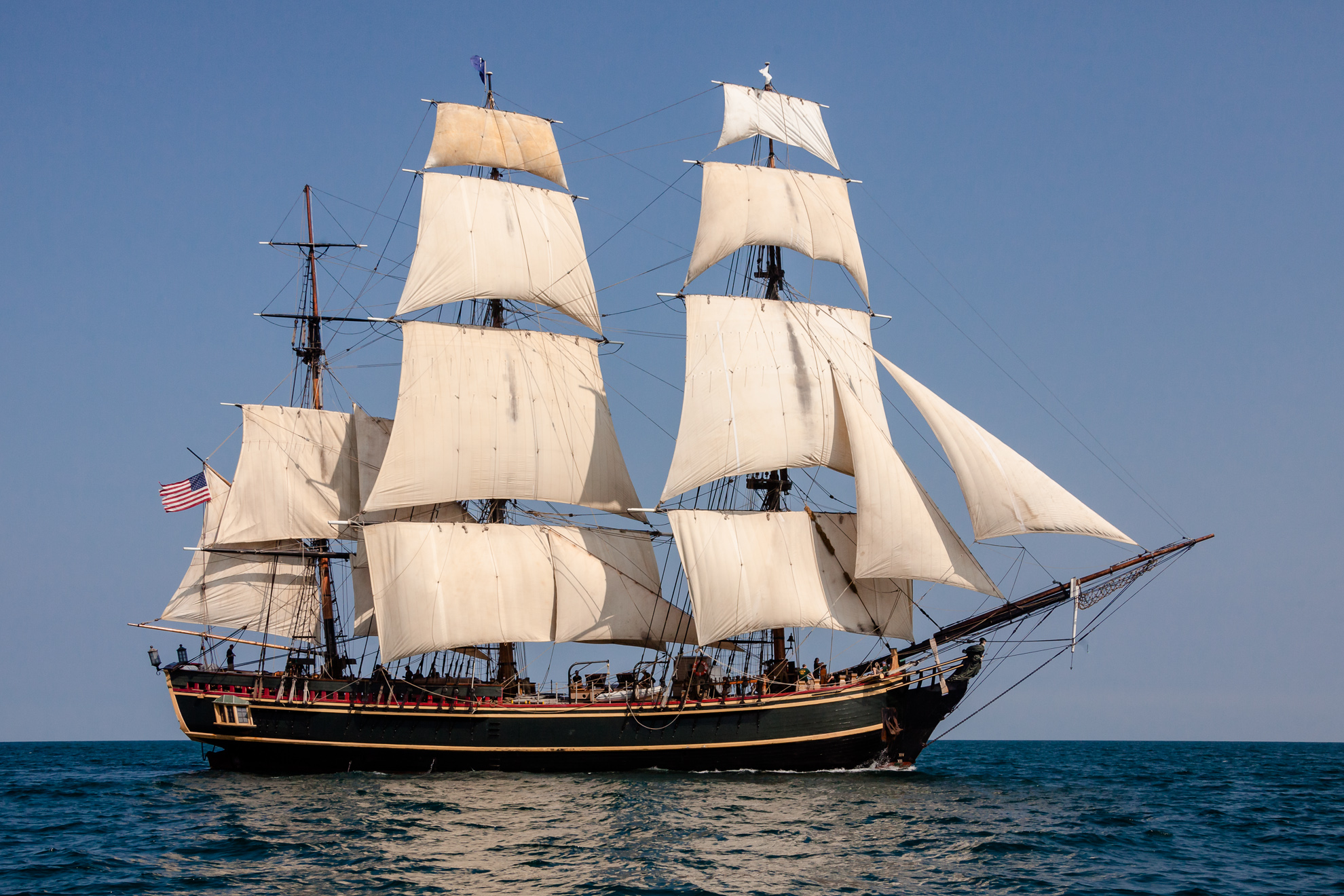 |
| HMS Bounty II 1960 Tall Ship with full sails on Lake Michigan |
The story of the mutiny on the Bounty has since become an enduring legend, inspiring numerous books, plays, and films. The tale's themes of rebellion, survival, and the clash of cultures have resonated with audiences for generations. The mutiny also had significant implications for the Royal Navy, leading to changes in naval discipline and the treatment of sailors.
The mutiny on the Bounty is often interpreted through psychological and sociopolitical lenses. On a psychological level, the mutiny can be seen as a case study in leadership failure, group dynamics, and the impact of isolation and stress on human behavior. Bligh's authoritarian leadership style, while effective in maintaining discipline, ultimately proved counterproductive, as it alienated the crew and created an environment ripe for rebellion. Christian's descent into despair and eventual decision to lead the mutiny can be understood as a response to the unbearable pressure and emotional turmoil he experienced.
Sociopolitically, the mutiny reflected the broader tensions of the late 18th century, a time when the rigid hierarchies of European society were increasingly being challenged. The Enlightenment ideals of individual rights and resistance to tyranny, which had fueled the American and French Revolutions, also found expression in the mutiny on the Bounty. The crew's decision to mutiny can be seen as a rejection of the oppressive conditions imposed by Bligh and a quest for freedom, even if that freedom came at the cost of defying the established order.
The mutiny also highlighted the cultural clash between the European crew and the Polynesian societies they encountered. The allure of the Tahitian way of life, with its perceived abundance, freedom, and sensuality, stood in stark contrast to the rigid discipline and harsh conditions of life aboard the Bounty. The mutineers' decision to stay in Tahiti or settle on Pitcairn Island can be seen as a rejection of European civilization in favor of a simpler, more natural existence.
The mutiny on the Bounty had a lasting impact on naval discipline and maritime law. In the wake of the mutiny, the Royal Navy recognized the need to address the underlying causes of discontent among sailors. While discipline remained strict, there was a growing recognition of the importance of fair treatment and the need to prevent the kind of abusive behavior that had contributed to the mutiny.
The Bounty mutiny also influenced the development of maritime law, particularly in relation to issues of authority, obedience, and the rights of sailors. The court-martial of the mutineers set important precedents for the treatment of mutiny cases, emphasizing the seriousness of the offense while also acknowledging the complex factors that could lead to such an extreme act of rebellion.
The mutiny on the Bounty remains one of the most iconic and enduring stories of rebellion at sea. The event, rooted in the personal dynamics between Bligh and Christian, the challenging conditions of naval life, and the broader socio-political context of the late 18th century, continues to captivate scholars and the public alike. The mutiny's legacy is evident in its lasting impact on naval discipline, maritime law, and popular culture, as well as in the continued fascination with the tale of Fletcher Christian and his fellow mutineers.
The Bounty mutiny serves as a powerful reminder of the complexities of leadership, the consequences of tyranny, and the enduring human desire for freedom and self-determination. It is a tale that resonates across time, offering valuable lessons about the nature of authority, the power of resistance, and the unpredictable outcomes of human actions in the face of adversity.
Sources
Alexander, Caroline. *The Bounty: The True Story of the Mutiny on the Bounty*. New York: Viking, 2003.
Bligh, William. *The Log of the Bounty: A Voyage of the South Seas*. Edited by Robert Bowman. New York: Penguin Books, 1975.
Dening, Greg. *Mr. Bligh's Bad Language: Passion, Power, and Theatre on the Bounty*. Cambridge: Cambridge University Press, 1992.
Hough, Richard. *Captain Bligh and Mr. Christian: The Men and the Mutiny*. London: Hutchinson, 1972.
Lewis, Michael. *England's Sea-Officers: The Story of the Naval Profession*. London: George Allen & Unwin, 1939.
McAleer, John. "‘Savage Shores’: The Pacific Voyages of Cook, Bligh, and Vancouver." *Journal of British Studies* 51, no. 2 (2012): 249-272.
Nechtman, Tillman W. *Nabobs: Empire and Identity in Eighteenth-Century Britain*. Cambridge: Cambridge University Press, 2010.
Kennedy, Gavin. *Bligh*. New York: Dodd, Mead & Company, 1978.
Salmond, Anne. *Bligh: William Bligh in the South Seas*. Berkeley: University of California Press, 2011.
Thomas, Nicholas. *Discoveries: The Voyages of Captain Cook*. London: Penguin, 2004.
Kasberger, Dan. English: HMS Bounty II 1960 Tall Ship with Full Sails on Lake Michigan near the Port of Chicago for the 2010 Great Lake Tall Ship Challenge. August 24, 2010. Own work. https://commons.wikimedia.org/wiki/File:HMS_BOUNTY_II_with_Full_Sails.jpg.
“War Daddy Pub! — April 28,1789: Mutiny on the HMS Bounty. Three...” Accessed August 28, 2024. https://damien813.tumblr.com/post/117591767633/april-281789-mutiny-on-the-hms-bounty-three.
Comments
Post a Comment